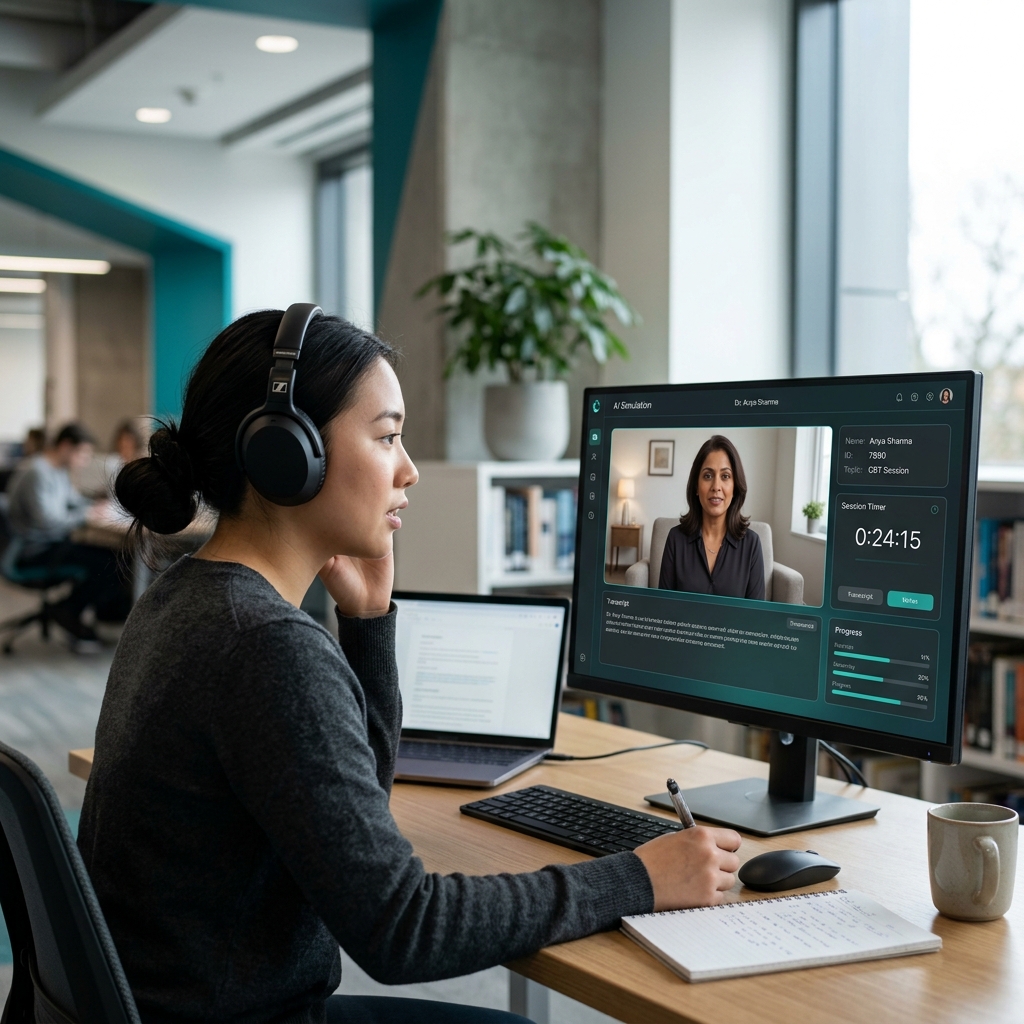
Providing AI clinical simulation as an optional, self-directed study resource consistently results in low student uptake—even when the technology is seamless and aligned with coursework. For simulation to drive meaningful clinical skill development, educators must embed it directly into the curriculum as guided classroom practice and formal assessment (such as hurdle tasks or graded reflective exercises).
We recently provided AI simulation access to a cohort of 300 students. Only one student used it. 'What is going on here?!' was my immediate reaction. We had spent weeks getting the technology right—making the platform scalable, secure, and as low-friction as possible. We worked closely with the academic team to ensure the simulation faithfully matched the static version of the learning activity: applying theoretical frameworks of verbal de-escalation to an acute, simulated clinical scenario. Yet 299 out of 300 students walked right past it.
Diagnosing the Engagement Gap: Four Hypotheses
When an educational tool with clear pedagogical value sees less than 1% adoption, it forces an honest look at how students actually make decisions about their time and energy. Looking closely at the rollout, four potential explanations emerged:
- ✓Lack of clarity on the exercise's purpose — Perhaps students did not fully grasp the learning objective of the simulation. While clearer onboarding is always helpful and easily fixable, a communication gap alone does not explain near-zero uptake.
- ✓Anti-AI sentiment — Could resistance to AI-based learning activities be driving students away? Some students certainly hold reservations about artificial intelligence, but 99% of a 300-student cohort? That still does not explain the numbers.
- ✓The Week 12 crunch — We deployed the simulation in Week 12, arguably the most gruelling week of the academic semester. Students are stressed, overworked, and simply trying to stay afloat. Year after year, learning analytics confirm that Week 12 marks the lowest engagement point of the semester. Timing certainly hurt—but there was still a deeper structural cause.
- ✓It was neither mandatory nor assessed — This is the real culprit. Presenting simulation as a 'nice-to-have' optional extra makes it almost impossible for time-poor students to prioritise the activity—and therefore to realise the value of the active learning and reflective process that simulation provides.
Why 'Optional' Quietly Kills Clinical Innovation
In higher education, assessment is the de facto curriculum for overwhelmed students. When learners are juggling final essays, exam preparation, paid work, and personal responsibilities, they operate on strict cognitive triage. Anything labelled 'optional supplementary practice' is quietly dropped—no matter how engaging, realistic, or pedagogically sound the tool may be.
There is also a subtle psychological barrier at play. Stepping into an interactive clinical simulation—even with an AI patient—can feel exposing. Reading a static case study is passive and safe; speaking aloud to de-escalate a distressed digital client requires vulnerability. Getting it wrong in front of an AI still feels like getting it wrong. When an activity is both optional and psychologically demanding, avoidance is the natural default.
| Implementation Dimension | Ad-Hoc / Optional Rollout | Curriculum-Embedded Rollout |
|---|---|---|
| Student Framing | Supplementary 'nice-to-have' study resource | Core component of weekly skills training and assessment |
| Deployment Timing | Late semester (e.g., Week 12 exam crunch) | Scaffolded progressively from early-semester tutorials |
| Psychological Safety | Isolated individual trial; high initial hesitation | Normalised in class together before independent practice |
| Assessment Link | Unassessed; zero credit towards unit grade | Hurdle requirement, formative reflection, or graded task |
| Typical Cohort Uptake | < 5% (only the most self-directed learners) | 95–100% cohort engagement and completion |
How to Embed Simulation into the Curriculum
Reflecting on this rollout made one lesson unmistakably clear: building great technology and aligning it with academic theory is only half the battle. For wider, meaningful adoption of clinical simulation, it must be structurally embedded into the curriculum across two pillars—learning and assessment.
- ✓Classroom skills practice (Learning) — Introduce the simulation inside scheduled tutorials or workshops first. When students try a de-escalation scenario together in small groups or observe a live educator demonstration, the initial fear of making mistakes evaporates. Simulation becomes a shared, normal part of weekly skills practice rather than an intimidating solo task.
- ✓Threshold or hurdle tasks (Formative Assessment) — Require students to complete a set number of simulated encounters as a mandatory pass/fail hurdle before progressing to clinical placements or sitting an OSCE. This guarantees every student builds baseline procedural fluency.
- ✓Reflective and direct clinical assessment (Summative Assessment) — Use the simulation as the assessment itself, or pair a completed simulation transcript and AI feedback report with a graded critical reflection where students analyse their de-escalation strategies against theoretical models.
- ✓Strategic semester timing — Introduce low-stakes simulation early in the teaching period (Weeks 2–4) to build familiarity and confidence long before late-semester assessment fatigue sets in.
Students rarely discover the transformative value of clinical simulation until they are inside the conversation—navigating resistance, hearing their own pacing, and reflecting on the immediate feedback. By moving simulation from the margins of 'optional extra' to the core of classroom learning and assessment design, educators ensure that every student—not just the one in three hundred—gets the practice they need to become placement-ready.
Frequently Asked Questions
Dr. Tuki Attuquayefio
Building the future of psychology education with clinical simulation.