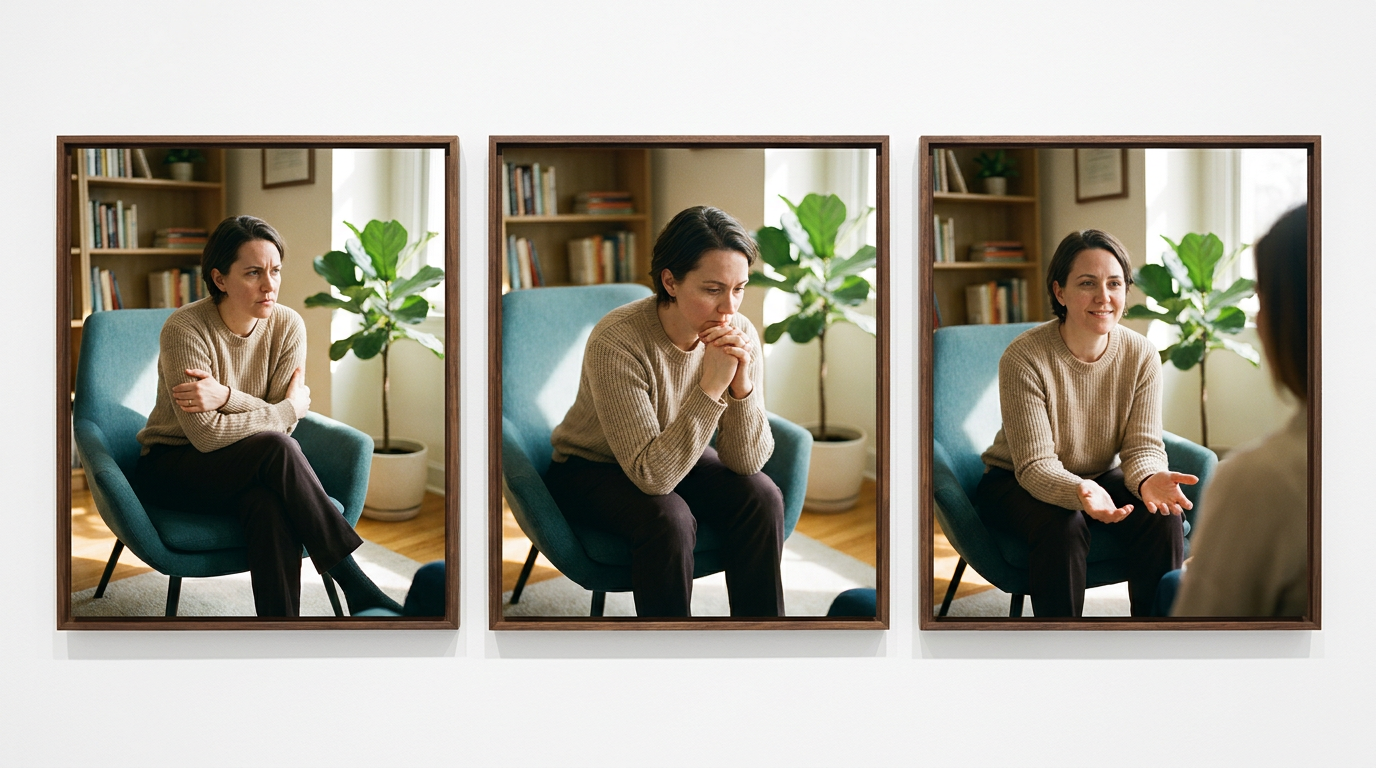
Psych Ready is not 'AI-powered' in the sense of letting a large language model invent how a virtual client feels or behaves. Instead, while conversations remain dynamic and unscripted, deterministic clinical state logic governs how the client reacts to what the trainee says—combining code we call the 'Emotional engine', structured cultural profiles, and modality-specific clinical schemas to constrain the language model's output. The language model is used strictly as a linguistic rendering tool—generating spoken dialogue and vocal inflection aligned to the client’s exact emotional state at that moment. Importantly, the voice and the face match in real time what the LLM generates. This synchronises what is said and how the client feels in response to trainee input.
Most AI role-play tools begin with a single system prompt: 'You are a 45-year-old experiencing anxiety. Act realistic.' That approach makes a product 'AI-powered'—and clinically unreliable. Left to its own devices, a large language model defaults to sycophancy. It wants to be helpful. Ask an open question and the chatbot folds immediately, volunteering deep childhood trauma on turn two before a trainee has even established basic rapport. These types of clients also drift over time, dropping in and out of character and ruining the realism of simulation.
At Psych Ready, we took a fundamentally different engineering path. We say we are not AI-powered; we use AI as a tool. Our simulations remain fully dynamic and unscripted—never rigid decision trees—yet the language model never decides who the client is, what beliefs they protect, or how their mood shifts. Deterministic clinical state logic and structured formulations govern how the client feels and responds, constraining the language model's output so every conversational turn stays grounded in the client’s clinical profile.
The Cultural Layer: Detailed Profiles Rooted in Culture and Lived History
Real clients do not walk into a consultation room as blank diagnostic labels. They arrive carrying family expectations, cultural norms, occupational strain, physical health histories, and past experiences with institutions. Every Psych Ready simulation starts with a rich profile spanning demographics, presenting problem, biological factors, psychological and trauma history, social context, and explicit rules of engagement.
Critically, cultural identity is never cosmetic window-dressing—it shapes how distress is experienced and what earns trust in the room. Take this example from our scenario library:
- ✓Ali (52, Lebanese-Australian café owner) carries strict family expectations around financial provision, undisclosed anxiety masked by irritation, hypertension, and a proud, defensive affect. Cultural expectations around breadwinning mean premature advice triggers immediate resistance.
Modality Embedding
A biopsychosocial profile tells us who the client is; modality embedding tells the simulation how that client’s internal world operates under a specific clinical modality. Because the same person presents differently depending on what the practitioner is trained to explore, our schemas embed modality-native psychological structures.
When a psychology student enters a Cognitive Behavioural Therapy (CBT) simulation, the client profile activates a full CBT cognitive architecture:
- ✓Core Beliefs — Deeply held, unarticulated schemas such as Ali’s belief: 'I must be successful and provide for my family, otherwise I am a failure.'
- ✓Intermediate Beliefs — Conditional rules linking behaviour to survival, such as: 'If I stop working so hard, the business will fail.'
- ✓Automatic Thoughts — Surface-level cognitions that show up immediately in dialogue ('I deserve a drink after working a 14-hour shift' or 'My wife doesn't see how hard I work').
- ✓Compensatory Behaviours & Conviction Score — Measurable baseline habits (overworking, self-medication) paired with an explicit starting conviction score (e.g., 85/100).
Just as in real clinical work, prompting rules built around this cognitive architecture forbid the client from blurting out their core belief on demand. The client lives inside their automatic thoughts. Only when a student uses skilful Socratic questioning or the downward arrow technique does the client begin examining the deeper belief beneath. Conversely, if a trainee jumps straight to lecturing or tells the client their thinking is 'wrong', the model’s instructions force conviction higher and deepen resistance.
Code Drives the Emotion, Not the Prompt
This is the architectural boundary that separates simulation software from an unconstrained chatbot. Between what the student says and what the client replies sits our deterministic emotional engine.
Whenever a student’s intervention shifts the clinical dynamic, the session triggers the emotional engine to change the client’s emotional state, which updates the AI, voice, and face simultaneously. So, when the client gets annoyed, it is simulated in their words, voice, and face in real time. This is what makes Psych Ready truly unique.
| Design Dimension | Typical 'AI-Powered' Chatbot | Psych Ready (AI as a Tool) |
|---|---|---|
| Who Controls Client Emotion | The LLM improvises mood and agrees easily with users | Code updates emotional state and generates appropriate call to AI |
| Cultural Context | Surface-level stereotypes or ignored after a few turns | Detailed client profile with norms, trauma history, and engagement rules compiled continuously |
| Therapeutic Modality | Generic advice-giving regardless of framework | Client profile sits in the context of a therapeutic modality and informs how they respond |
| Visual & Vocal Alignment | Text-only or mismatched cheerful avatar tone | Code triggers appropriate facial micro-expressions and vocal delivery that all match the updated emotional state |
| Clinical Auditability | Opaque black-box conversation | Every shift is timestamped for debrief and tracking, allowing trainees and supervisors to find exact moments clients shift |
Why Educators Should Care About the Architecture
In psychology and counselling education, realism is not a parlour trick. If a simulated client breaks character to applaud a clumsy interpretation, or yields a core belief without Socratic scaffolding, trainees build false confidence that collapses on their first human placement.
By keeping cultural identity, therapeutic theory, and emotional state transitions inside deterministic clinical state logic—and using AI strictly to generate dynamic, unscripted dialogue constrained to that state—we give universities standardised, psychologically faithful clients. Every shift has a clinical reason, and every trainee earns trust the same way they will in practice. Just as importantly, this architecture creates something defensible, transparent, and auditable—giving educators, supervisors, and institutions a product they can trust.
Frequently Asked Questions
Dr. Tuki Attuquayefio
Building the future of psychology education with clinical simulation.