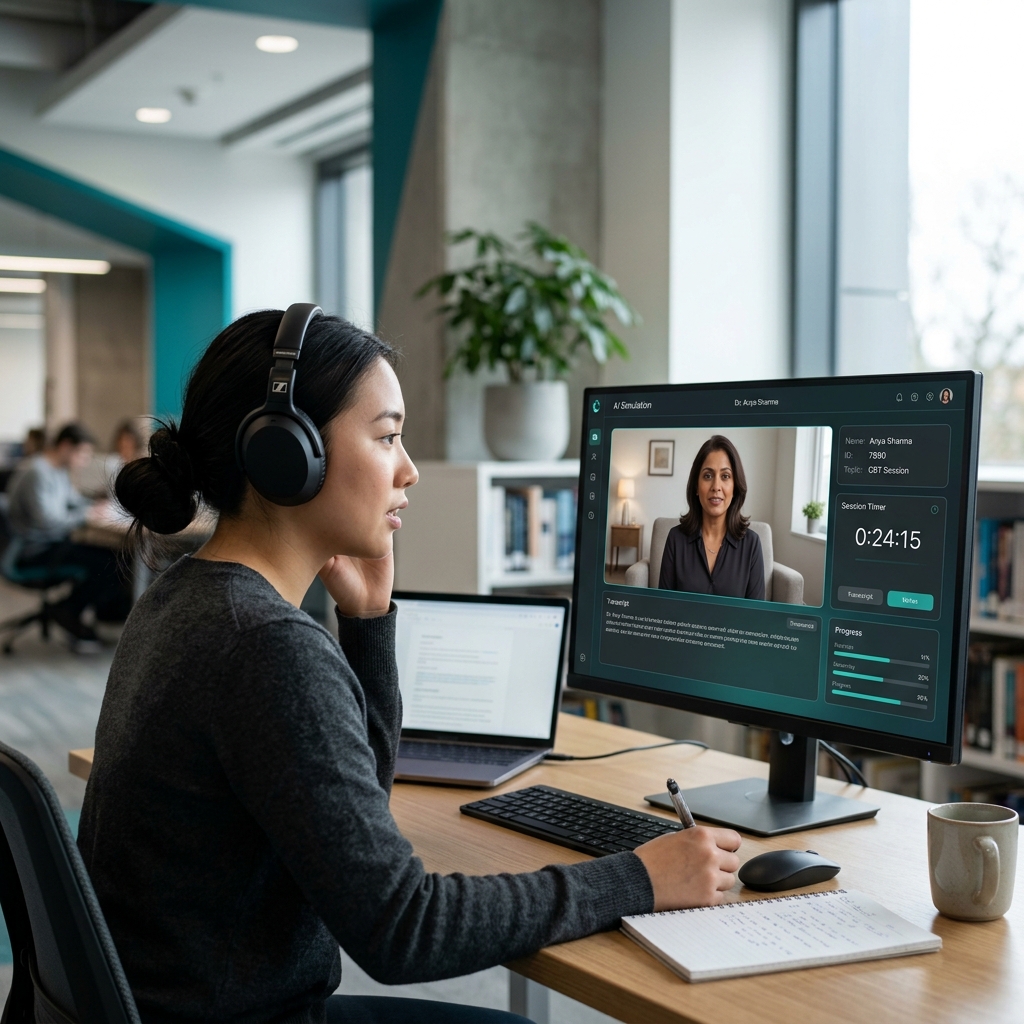
The Family and Multi-Disciplinary Team (MDT) Sandbox is an immersive, multi-agent simulation where student clinicians practice systems-level clinical work. Students facilitate case conferences or family therapy sessions with multiple distinct AI agents (such as defensive family members, school counselors, or general practitioners) who interact in real-time, responding dynamically to conflict-resolution strategies and clinical boundaries.
In clinical psychology and social work education, one-on-one therapeutic skills are heavily prioritised. Students learn to conduct an individual intake, construct a single formulation, and execute standard therapies. Yet, real-world mental health care is rarely an isolated dyad. Once students enter placements, they are immediately thrust into complex systems. They must present case formulations to multidisciplinary teams (MDTs), coordinate care with hostile GPs, or facilitate highly charged family sessions where parents, siblings, and guardians hold conflicting views. Under the current educational model, students rarely, if ever, practice managing these multi-person dynamics before placements.
The Pedagogical Gap in Systems-Level Training
Standardized patient programs have historically been unable to bridge this gap. While hiring a single actor to play a client is financially taxing, hiring three or four actors to simulate a family therapy session or an inter-professional case conference is cost-prohibitive for almost all university budgets. Peer role-plays also break down in multi-person scenarios, as students struggle to simultaneously portray several distinct professional or family roles with clinical realism. As a result, students miss out on mastering critical systems-level competencies: mediating inter-personal conflict, maintaining clinical authority in a crowded room, and advocating for client-centred care among diverse, strong-willed professional peers.
How the Multi-Disciplinary & Family Sandbox Works
The sandbox solves this by leveraging a stateful, multi-agent AI system. When a student enters a case conference simulation, the room is populated by multiple distinct AI agents—such as a defensive parent, an over-worked social worker, and a school principal. Each agent acts on their own independent psychological blueprint, personality traits, and operational agenda. As the student speaks, all agents listen and react to both the student and to one another. If the student fails to set boundaries early, the defensive parent may monopolize the session, while the social worker becomes increasingly disengaged. If the student uses collaborative mediation techniques, they can successfully lower the tension in the room and build a unified, inter-disciplinary treatment plan.
| Dimension | Traditional Simulation | Family & MDT Sandbox |
|---|---|---|
| Participant Scale | One-on-one dyad (therapist and individual client) | Multi-agent systems (therapist, family, and other professionals) |
| Dynamic Complexity | Linear, conversational turn-taking | Non-linear, multi-directional interactions and alliances |
| Skill Focus | Intake, individual assessment, active listening | Conflict mediation, systemic formulation, care coordination |
| Professional Role | Individual therapist | System facilitator, mediator, and inter-professional advocate |
| Cost & Scalability | High cost for single standardized patient | Highly scalable, multi-person scenarios with zero extra cost |
The Impact on Placement Readiness and Competency Standards
Transitioning from academic coursework to system-level practice is one of the primary sources of anxiety for students entering clinical placements. Training with a Family and MDT Sandbox builds 'systems muscle memory' in a psychologically safe environment. Students learn how to structure a family session, how to tactfully interrupt cross-talk between defensive family members, and how to present clinical case formulations in front of diverse medical professionals. They build the somatic resilience needed to stay calm and grounded while managing a room full of competing priorities.
For educators, this technology directly aligns with dynamic competency mapping across multiple mental health disciplines—including psychology, counselling, mental health nursing, medicine, and psychiatry—ensuring students demonstrate competency in working within multidisciplinary contexts and collaborating with families and carers. By embedding these multi-agent sandboxes, programs can assess and document these advanced competencies objectively, ensuring students are truly placement-ready from day one.
Frequently Asked Questions
Psych Ready Team
Building the future of psychology education with AI-powered clinical simulation.